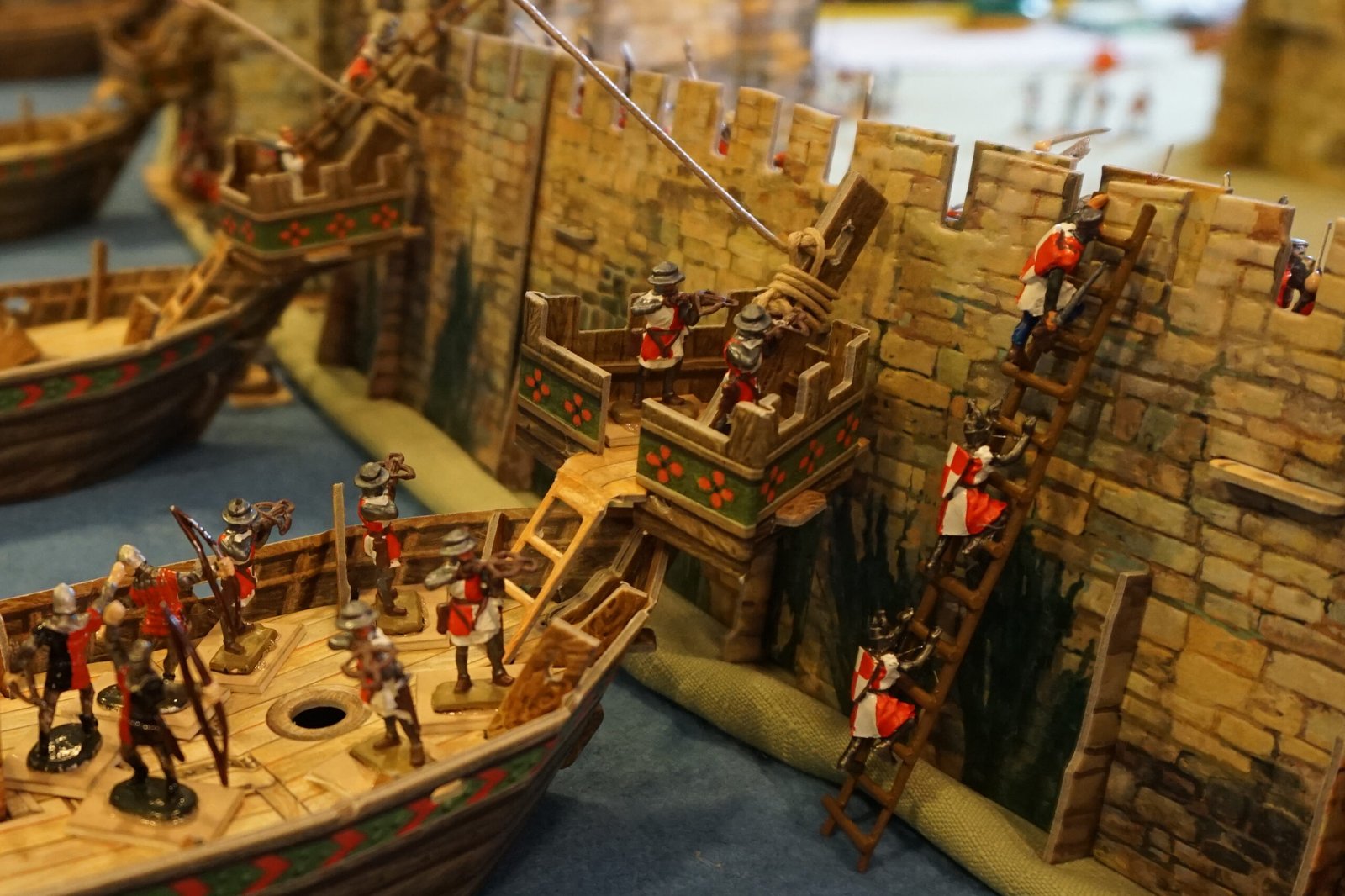


This year’s Battle Day was held at Hermitage Village Hall in Berkshire on Sunday 30th March and showcased The Battle of Maldon, the 991AD encounter in Essex between the English army of Byrhtnoth and the Viking raiders of (probably) Olaf Tryggvason. Immortalised in the eponymous Anglo-Saxon poem, the battle provided plenty of challenges to stage, including uncertainty over relative numbers of both sides, the role of missile troops in shield-wall warfare, the role of honour and wider politics in tactical decisions, and whether three legendary fighters could indeed hold a narrow causeway on their own against a Viking army…
The aim of the Battle Day, as ever, was to showcase a particular battle from The Society’s era of interest and explore different wargames rules to represent it. The day therefore acts as a catalyst for exploring the historiography of a particular battle, the options for recreating it in miniature and, of course, lots of good natured wargaming. Open to members and non-members alike, attendees can either book a table to run a game, turn up already associated with a specific game, or simply turn up and find a free slot (which most games have) and join in. The day opened with a presentation by Dr Matt Bennett on historical aspects of the battle which ably set the scene for the day’s activities and, once again, the Battle Day delivered a fantastic breadth of wargames rules, figure scales and historical interpretations. A total of 15 games were staged, with 13 different rules sets used and four different figure scales.
| Rules | Figure Scale |
| Conquerors and Kings | 15mm |
| Longships | 15mm |
| Wargames Research Group 6th Edition | 28mm |
| Mortem et Gloriam | 28mm |
| De Bellis Magistrorum Militum | 28mm |
| Midgard (two separate games) | 28mm |
| Shieldwall | 28mm / 15mm |
| Dux Bellorum | 10mm |
| Milites Mundi | 6mm |
| Crusader Rules | 28mm |
| Lion Rampant (two separate games) | 28mm |
| Wyre Wargames Club’s Dark Age Infantry Slog | 28mm |
| Armati | 28mm |
Given that the historical location of the battle is fairly well established, the variety of interpretations was perhaps not as diverse as other Battle Days have been, but a pleasing spread of approaches were on display. Several games played out the holding of the causeway against the Vikings as a separate mini-game, the outcome of which influenced the conduct of the main encounter; others chose to set the start point as having the Vikings either crossed or in the process of crossing. It was interesting to see how different rules sets represented the grind of shield wall fighting, and a number wove in the importance of honour and heroic deeds in moderating the balance of advantage in the battle. The propensity for our miniature Dark Age heroes to engage in saga-worthy actions resulted in more than a few incidents worthy of a bard’s remembrance, for better or for worse!
It was also great to see the visual aspects of miniature wargaming being given a diverse showcase. In addition to the variety of miniature scales on display, a combination of terrain modelling techniques was also in evidence, with a number of games creating bespoke boards for the day. Ross Bigley was singled out by many attendees for his hitherto unrecognised skill of recreating realistic mud flats in miniature, adding an additional layer of authenticity to Tim Parsons’ 6mm 3D-printed armies which he assembled and painted for the day at a figure ratio of 1:1 – 2,200 tiny Englishmen faced off against 2,700 miniature Vikings.
Two Prizes were presented by society president Richard Lockwood, one voted by the attendees and the other selected by me from nominations given by the participants. Best Game was hotly contested, with several games attracting near equal votes; honourable mention went to Simon MacDowall’s Shieldwall game which had a separate (and high energy!) causeway mini-game, but following a tight vote the prize was awarded to Andrew Parrock for his Lion Rampant scenario, which also included a pre-game scenario and which ran several times in the course of the day. A number of valiant nominations were made for prize of ‘Deed Most Likely To Be Remembered In Poetry’ award, but the prize ultimately went to the inglorious fate of Rub Hutton’s forces in the Mortem et Gloriam game. Not all poetry is positive…
Finally a thanks and look forwards. No Battle Day is a success without the efforts of everyone who brings along a game, welcomes free-floating participants to join them, and inserts energy to make a great day’s gaming. Thanks to all participants for making the day a success.
Look forward: next year’s Battle Day will be Cunaxa, the decisive act of Cyrus The Younger’s failed revolt against Artaxerxes II in 401 BC, and the starting point of The Ten Thousand’s ‘March to the Sea’. Persians, hoplites and more. The Battle Day will be held on Sunday 29th March 2026, at Hermitage Village Hall (postcode RG18 9WL). Further details to follow on the Society Website and via Slingshot, alternatively email soabattleday@gmail.com for more information.
Photos (photo follows associated caption)
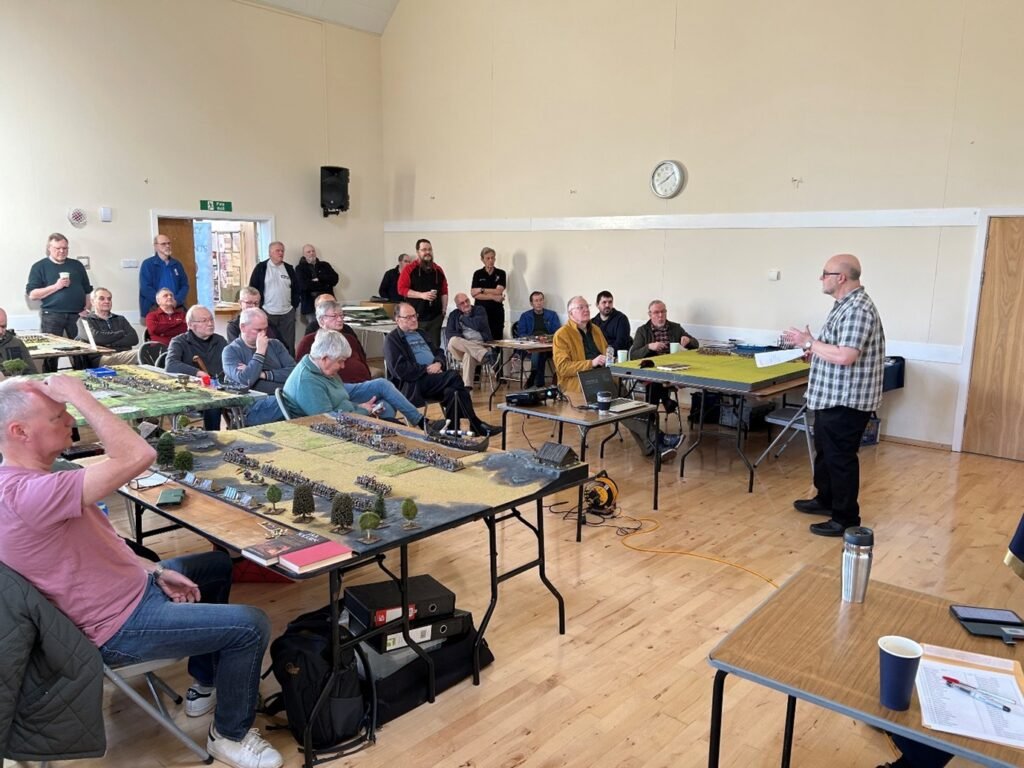
Matt Bennett gives his introduction to the battle:
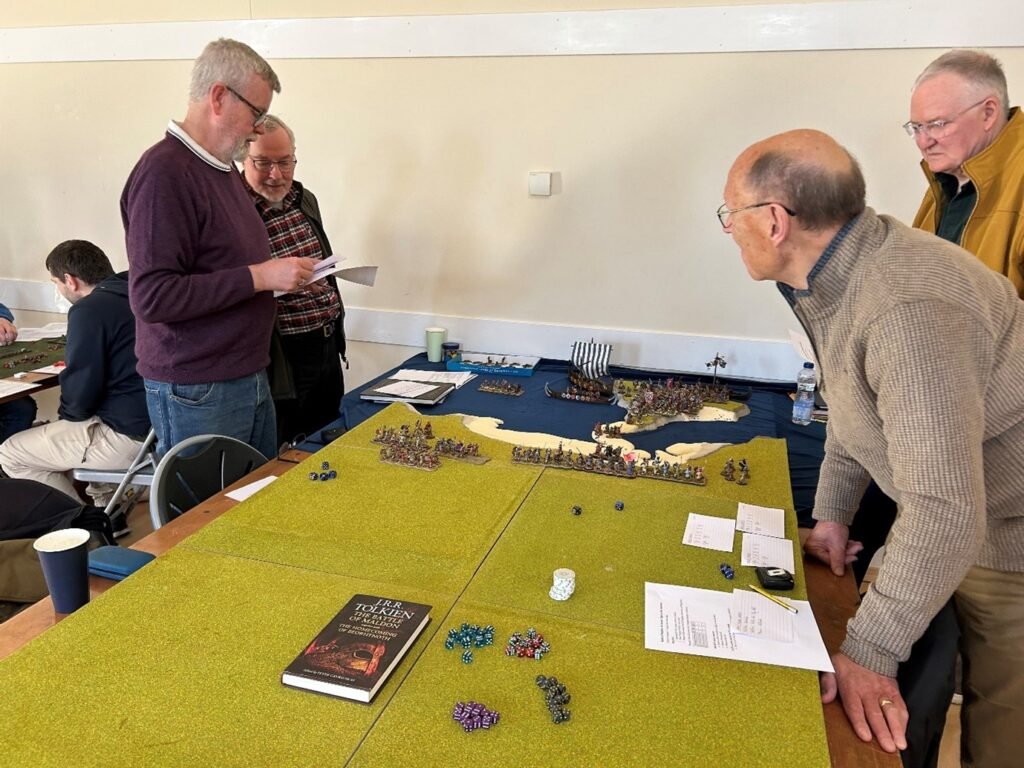
Simon MacDowall’s causeway pre-scenario:

Mudflats and Miniatures: 1:1 figure ratio battle-lines face off against each other:

Andrew Parrock’s ‘Best Game’ winning Lion Rampant scenario:
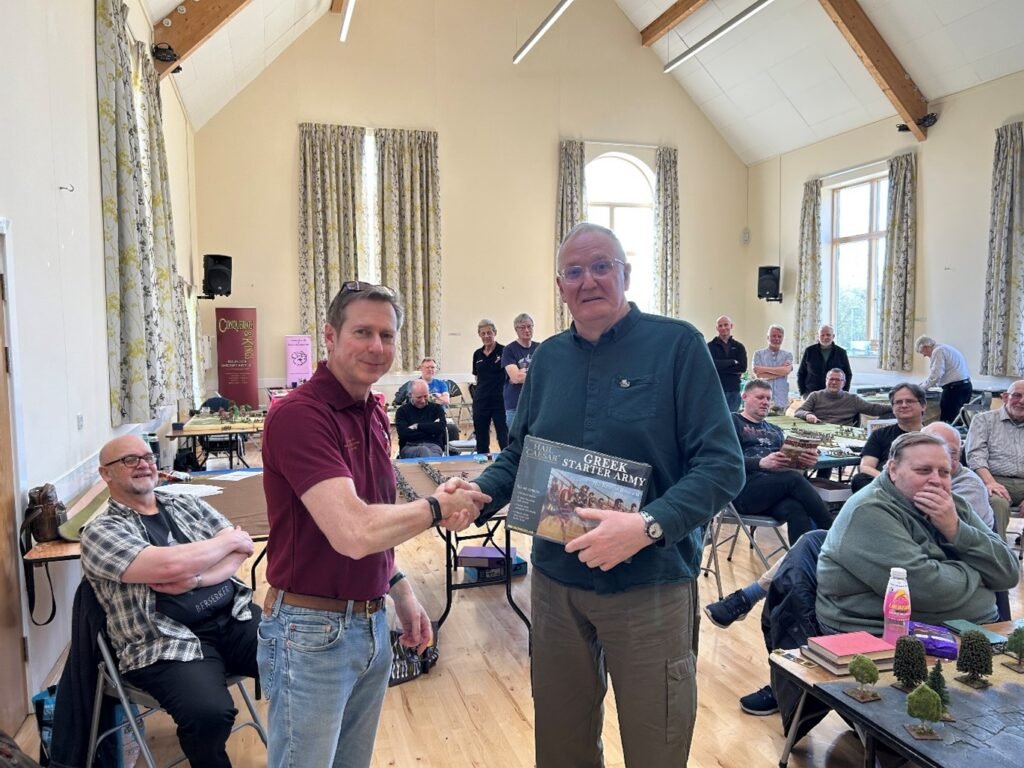
The Prize Winners: Andrew Parrock (Best Game):
Rob Hutton (Deed Most Likely To Be Remembered In Poetry):
